Your cart is currently empty!
Sticky vs Rotating Proxies: Which Keeps Accounts Safe
Sticky vs rotating proxies determine whether your multi-account setup runs clean or gets flagged in hours. Most operators default to rotation without understanding how it clashes with real browsing patterns.
This guide covers what each proxy type actually does, when rotation helps or hurts, and how to match your strategy to account value so you avoid bans and keep sessions intact. Written for operators running real accounts, not scrapers.
-
- What sticky and rotating actually mean
-
- When each makes sense
-
- Why rotation often hurts multi-account setups
-
- How to choose correctly based on account value, not convenience
First: What Sticky and Rotating Really Mean
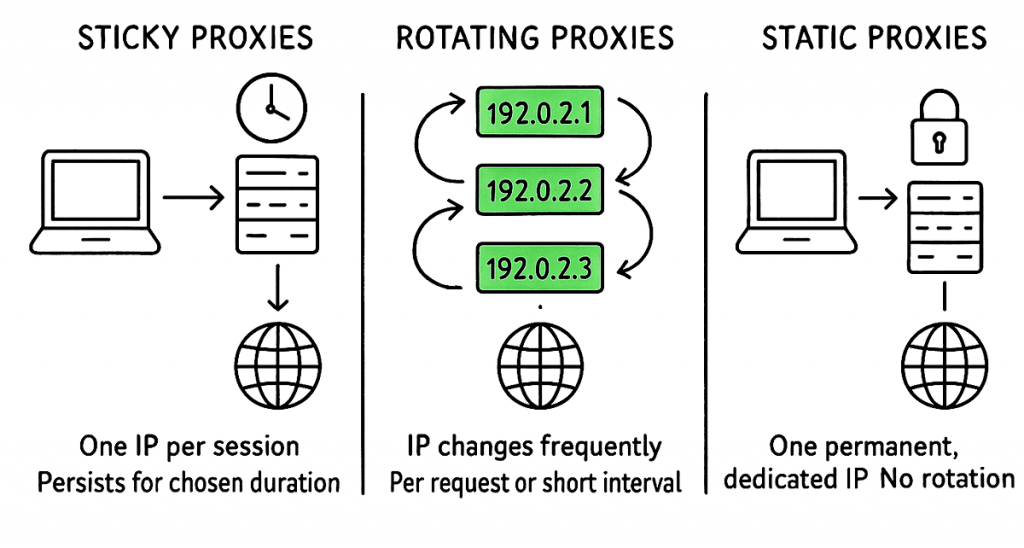
Sticky (Session-Based) Proxies
A sticky proxy keeps the same IP for a defined session.
-
- You control when the IP changes
-
- Sessions can last minutes or hours
-
- IP changes happen between sessions, not mid-activity
This mirrors how real users behave.
Rotating Proxies
Rotating proxies change IPs automatically.
-
- Rotation may be time-based or request-based
-
- IPs change whether you want them to or not
-
- Often shared across many users
This behavior is not how real users log in.
Why Rotation Is Dangerous for Multi-Account Logins
Rotation is often marketed as “safer”.
For multi-account usage, it’s usually the opposite.
What rotation breaks
For more details, see our guide on advanced proxy rotation strategies and timing patterns.
-
- Session continuity
-
- Identity consistency
-
- Login trust
Humans don’t:
-
- Switch networks mid-login
-
- Appear from multiple IPs in one session
-
- Bounce between carriers every few minutes
When that happens, platforms flag the behavior — even if the IPs are mobile.
Sticky Proxies Match Real User Behavior
Real mobile users:
-
- Connect to one network
-
- Stay connected during usage
-
- Lose or change IP occasionally, not constantly
Sticky sessions recreate this pattern:
-
- Stable IP during login and activity
-
- Rotation only when you end the session
-
- Predictable identity over time
This is why sticky mobile proxies are the baseline for serious multi-account work.
When Rotating Proxies Do Make Sense
Rotating proxies are not “bad”.
They’re just misused.
They make sense for:
-
- Scraping public pages
-
- One-off requests
-
- Non-login activities
-
- Tasks where identity continuity doesn’t matter
They do not make sense for:
-
- Account logins
-
- Ad accounts
-
- Long-term profiles
-
- Any workflow involving cookies and trust
The #1 Rotation Mistake (And Why It Causes Bans)
The most common mistake is mid-session rotation.
Example:
-
- You log into an account
-
- IP rotates while browsing
-
- Next request comes from a different IP
From the platform’s perspective:
Same account, same device, different network — instantly.
That’s not mobile behavior.
That’s automation behavior.
Sticky vs Rotating: Side-by-Side (Multi-Account Context)
| Factor | Sticky Proxies | Rotating Proxies |
|---|---|---|
| Login safety | ✅ High | ❌ Low |
| Session stability | ✅ Stable | ❌ Unstable |
| Identity consistency | ✅ Strong | ❌ Weak |
| Multi-account suitability | ✅ Best | ❌ Poor |
| Scraping efficiency | ⚠️ Medium | ✅ High |
For accounts that matter, this table answers the question.
How Long Should a Sticky Session Be?
There’s no single “correct” duration.
General guidance:
-
- Keep the IP stable for the entire login and activity period
-
- Rotate only when you:
-
- Close the browser profile
-
- End the session intentionally
-
- Switch days or workflows
-
- Rotate only when you:
What matters is predictability, not duration.
The Correct Rotation Strategy (If You Rotate at All)
If rotation is required:
-
- Rotate between sessions
-
- Never rotate during login
-
- Never rotate during active browsing
-
- Never rotate multiple times in one session
Rotation should feel like:
“User went offline and came back later.”
Not:
“User teleported across networks.”
Why Providers Push Rotation (Industry Reality)
Many providers push rotation because:
-
- It’s cheaper to operate
-
- IPs can be reused aggressively
-
- Control is removed from the user
That’s fine for scraping.
It’s dangerous for accounts.
If you don’t control rotation, you don’t control identity.
What to Look for in a Proxy Provider (Sticky Use Case)
For multi-account work, your provider must offer:
-
- Session-based stickiness
-
- Manual or predictable rotation
-
- No forced mid-session IP changes
-
- Clean mobile carrier networks
We built our mobile proxy infrastructure around session stability, not forced rotation:
- Sticky mobile IPs you control
- Rotation only when you choose
- No mid-session changes
Specs first.
Always.
When Sticky Is Non-Negotiable
Use sticky proxies without exception if:
-
- Accounts are aged or valuable
-
- You run ads or monetized profiles
-
- You use anti-detect browsers
-
- You care about long-term survival
Rotation is a convenience.
Stickiness is a strategy.
Final Takeaway
The question isn’t:
“Which proxy type is better?”
The real question is:
“Which behavior looks human over time?”
For multi-account usage:
-
- Sticky proxies build trust
-
- Rotating proxies break it
Choose accordingly.
Compare mobile and residential proxies here
Further Reading
For a deeper dive into static IP options, see our guide on non-rotating proxies—covering static residential, static mobile, and dedicated datacenter options. If you’re looking at rotating proxies for scraping rather than account management, learn how reverse rotating proxies automate IP cycling from the server side.